
DISCOVERY HOUSE
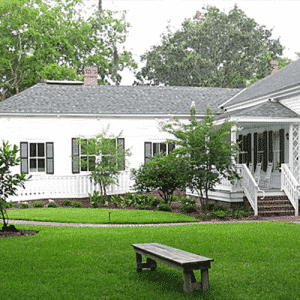
Named for being the gateway to your experience of Discovery at historic Honey Horn, we invite you to begin your journey at the oldest building on the property: the Discovery House. Dating back to 1859, this structure houses both permanent exhibits and one of kind temporary exhibitions that focus on the South Carolina Lowcountry’s natural history and cultural heritage. In addition to visiting the Museum Gift Shop, The Kids’ Zone (a children’s learning space), and accessing the community meeting room, guests can pick up a map of the property and information on our exhibits, walks, talks, and tours.
DISCOVERY
HOUSENamed for being the gateway to your experience of Discovery at historic Honey Horn, we invite you to begin your journey at the oldest building on the property: the Discovery House. Dating back to 1859, this structure houses both permanent exhibits and one of kind temporary exhibitions that focus on the South Carolina Lowcountry’s natural history and cultural heritage. In addition to visiting the Museum Gift Shop, The Kids’ Zone (a children’s learning space), and accessing the community meeting room, guests can pick up a map of the property and information on our exhibits, walks, talks, and tours.

TOM PEEPLES DISCOVERY LAB
Construction for the second oldest structure on site, the Supervisor’s House, was started just before the turn of the 20th century by William Clyde, the owner of Honey Horn at that time. The house was occupied by the property’s supervisor, J. E. Lawrence, and his family. Stabilized and raised out of the flood plain, the building was renovated and opened as the Tom Peeples Discovery Lab in 2016, Hilton Head’s only multiple-term mayor, who was instrumental in protecting and preserving the museum’s 70-acre Honey Horn property. Today, the building is home to educational programs, classes, workshops, family activities, and more.
During the school year, the Tom Peeples Discovery Lab is used for student field trips and is now home to several live animal displays used for our educational programs.
Please visit the School Programs page to learn more about educational opportunities available for students, groups, and educators, and contact information to schedule your group visit. Many of our public programs are also held in the Discovery Lab. Check the event calendar to see what's planned.
Explore the Lab during Discovery Lab Open House!
TOM PEEPLES
DISCOVERY LAB
Construction for the second oldest structure on site, the Supervisor’s House, was started just before the turn of the 20th century by William Clyde, the owner of Honey Horn at that time. The house was occupied by the property’s supervisor, J. E. Lawrence and his family. Stabilized and raised out of the flood plain, this building was renovated and opened as the Discovery Lab in the fall of 2016, where it’s actively used today for educational programming, classes, family activities, and more!
Check Open House Hours on Mondays & Thursdays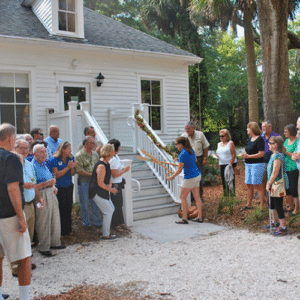
HORSE BARN
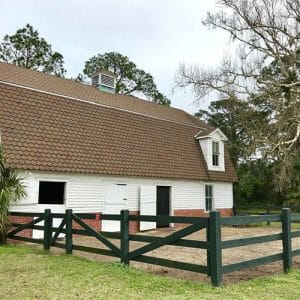
The Horse Barn is one of many buildings added in the 1930s by Honey Horn owners Landon K. Thorne and Alfred Lee Loomis. In 2010, two years after being renovated by the Coastal Discovery Museum, the Horse Barn became the onsite stable for marsh tacky horses – South Carolina's state heritage horse.
The museum is honored to have been the home of Comet, a beloved marsh tacky, who passed away in 2023, and his companion Hawk, a quarter horse, who spent 9 years at Honey Horn before returning to Heroes on Horseback, a therapeutic riding program, in 2025 to spend his sunset years.
HORSE
BARNThe Horse Barn is one of many buildings added in the 1930s by Honey Horn owners Landon K. Thorne and Alfred Lee Loomis. In 2010, two years after being renovated by the Coastal Discovery Museum, the Horse Barn became the onsite stable for marsh tacky horses – South Carolina's state heritage horse.
The museum is honored to have been the home of Comet, a beloved marsh tacky, who passed away in 2023, and his companion Hawk, a quarter horse, who spent 9 years at Honey Horn before returning to Heroes on Horseback, a therapeutic riding program, in 2025 to spend his sunset years.
POLE BARN
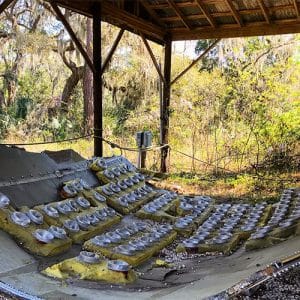
As you step up to the “Hack Family Equipment Shed,” built in the early 1950s to store farming and timber equipment, you find remnants of that era including a hay baler that has a tree grown around it. The surprise ‘artifact’ here is the 400-pound cowling of an Atlas V rocket that washed up on a Hilton Head beach in 2010! Learn about its payload from the interpretive label in this structure that’s known today as the Pole Barn.
POLE
BARNAs you step up to the “Hack Family Equipment Shed,” built in the early 1950s to store farming and timber equipment, you find remnants of that era including a hay baler that has a tree grown around it. The surprise ‘artifact’ here is the 400-pound cowling of an Atlas V rocket that washed up on a Hilton Head beach in 2010! Learn about its payload from the interpretive label in this structure that’s known today as the Pole Barn.